A guide to documenting protest movements
...and doing so ethically and powerfully
By Matt Hrkac
See also: A list of photographers who do this work ethically
Header image: 2023 Invasion Day rally in Naarm (Melbourne).
Introduction
Depending on your intentions, using your skills in image and video making to document activist movements and give voice to people and causes that are often ignored by the mainstream media can be a rewarding and fulfilling proposition.
You can use this to your advantage to counter and discredit mainstream media narratives; you can use it to protect people from being harassed and you can also lend greater public credibility to protest movements and causes that you support.
This guide is being written as, in my personal experience, there's been a few cases of protest photographers not being entirely across etiquette or worse, ethics. Hence this guide is also to ensure everyone is on the same page. Months in the making; there has also been some demand, in the last year in particular, for such a resource. If you feel there's anything I've missed, please reach out. If you find this guide to be useful, you're encouraged to share or republish (provided a link back to this page is provided).
This guide is split into three broad sections: logistics of protest actions and how photographers fit, the creative and technical aspects, and storytelling and reportage. You can use the quick navigation below to jump to various sections of this guide.
Before you begin...
Note: This guide isn't going to cover the basics of camera operation and settings - for more information, read the existing blog posts on Aperture, ISO, Shutter Speed and Lens Focal Lengths.
First of all, ask yourself why you're doing this. Is it to document? Is it to help promote the cause? Is it to report? Or are you looking to get images that you can sell to the media? Knowing why you're at a protest will inform your intentions.
Yes, it's easy enough for any random person to acquire a camera, take themselves along to a protest and start taking photos. It doesn't necessarily mean that you should do this - especially if you're not already known for doing this sort of work or if you're new to protest movements in general.
In saying that, those who do want to do this sort of work have to begin somewhere, and that somewhere isn't necessarily picking up a camera and coming in out of nowhere.
No matter how well your intentions are, coming in out of nowhere will be looked at with suspicion by people around you - for good reason too: agitators also bring themselves and their cameras along to protests for the purpose of harassing attendees. There's mainstream media that are more often than not after 'riot porn' or the 'money shot' than caring about the well-being of people on the ground, etc.
Being identified with either of the above or as anyone who doesn't have good intentions isn't a good start and leads to a loss of trust. Once trust is lost, it can be difficult to regain.
As such, knowing what your intentions are is important. If your intentions are truly to support the protest movements and causes that you're seeking to document, then great!
If you have a profit motive, wanting to furnish your own ego; if you're going out to discredit people and the movement, etc then by all means, do so - but you're not going to be very warmly welcomed for long.
A middle ground here may be simply reporting on what's going on rather than undermining the cause or actively supporting it. People simply reporting are usually welcome at protests, though you should ensure you have credentials i.e. are displaying a press pass, or be ready to calmly explain your case if someone asks.
In Australia, membership of the Media section of Media, Entertainment and Arts Alliance's Freelance Pro section comes with a membership card that can be used as a press pass. However you actually need to be earning money as a photographer (even if only a small amount) to be eligible for membership.
Note that taking this route will mean finding out information on a basis of people wanting you to know about it, for example, through a media release or through social media, rather than being told on a need to know basis ahead of time.
If you're intending to actively support the cause by documenting it - then it helps to have rapport with people involved in the movement before doing any filming or photographing.
This can involve active participation in protest movements, going along to meetings and contributing to organising in good faith and with genuine intent. That way, once you start bringing a camera along to events and offering to take photos - people will know who you are because you'll have that rapport and trust.
Starting out and building trust
If you've chosen to go down the observer and reportage avenue as described above, there isn't really much you need to do. It helps, however, to still build relationships on a professional basis on the ground with the people you're documenting, particularly with key organisers.
If you're actively supporting the cause through your documentation, then hopefully you've done the preliminary work as described above. Just because you're on the ground role is documenting, doesn't necessarily mean you should stop contributing behind the scenes either.
In either case it comes down to building relationships and trust. If you do the right thing by other people, they'll do the right thing by you.
As such, you can demonstrate your support by making your images freely available to the organisers of the protest movements you're documenting. More often than not, grassroots groups and organisations will want good quality images and footage from actions and protests for propaganda purposes. Offer them your images and ask them to credit you for their use.
This not only helps you build trust but also gives you name recognition, and ties it to your role.
When documenting protest movements, you'll obviously be taking photos of people. When out in public, people have no assumed right to privacy - meaning, it's up to individuals as to whether or not they choose to obscure their identity.
Furthermore, despite what some may say - it's not always possible to seek verbal consent on the ground, but it's usually always possible to make your intentions clear through your body language.
With that being said, if someone in a photo that you post publicly asks you to take that image down, for whatever reason, the rule of thumb here is to comply with that request. It doesn't matter how good you think the image is. The only exception to this rule is if you can explicitly demonstrate that there's no additional risk with the image being kept public.
As an example - I recently posted an image taken at a protest of someone, clearly identifiable, holding a coloured smoke emitter. A few people assumed that it was a marine distress flare - which aside from on maritime vessels, are illegal to posses and use. Smoke emitters, however, are perfectly legal and are readily sold online and in party shops. Upon reassuring those concerns, people were fine with that image remaining public.
In a couple of other cases - a person featured prominently in an image that I had posted contacted me requesting that image be taken down on grounds that they'd prefer that the image of them not be public. I complied with those requests without question.
This all ties in to building and maintaining trust.
Image above: a pro Palestine rally in Naarm (Melbourne).
What and what not to post and take photos of
At rallies, you’ll end up taking photos of people in all sorts of situations. Most of these situations will be innocuous and benign. Others will be a bit more dicey. Here's a list of situations that you may encounter at protest actions and whether or not it's advisable to publish such content:
Crowds, signage, people at a public rally
Definitely post!
Generally speaking, this is the sort of imagery people want to be public. Rally attendees have a message that they want to disseminate to wider audience and public and you publishing images of their signs, of the crowds, etc gives them an avenue to do that.
As mentioned above, if someone requests that you take an image of them down after you publish - do comply with that request.
Police aggression towards protesters
Post. But contextualise
Police aggression and violence towards even entirely peaceful protest actions has been increasing in recent years. This is usually safe to post, so long as you contextualise and so long as the images can't be seen as depicting violence by identifiable protesters towards police.
Contextualising and explaining to your audience what's going on in a specific situation is important, rather than sharing images with no context.
It's also good to post a mix of images from the rally or action itself, rather than police violence towards protesters on its own.
Protesters receiving medical treatment
Do not post! Don't take photos or record footage unless consent is given
In fact, don't take photos at all and if you see other photographers taking photos, here's your chance to intervene and prevent them from doing so.
Police may deploy OC spray and other weapons against protesters that results in people being injured, and subsequently treated.
In some circumstances, for example, if explicit consent is given, it may be OK to take photos for internal and legal purposes but such images should never be made public without the express consent of the people involved.
People doing illegal stuff
It depend (err on the side of caution)
If a person is masked and completely unidentifiable in carrying out such actions - such as graffiti, vandalism, etc - it's likely safe to post the image.
I tend to err on the side of caution and avoid posting images (or even taking photos to begin with) showing anyone doing illegal stuff, regardless, instead opting for images of the finished 'work'.
Protesters being violent towards police
Don't post
This is one of the few lines that defines photojournalists from documentary photographers. The former are chasing the news (and protesters getting in to a punch on with the cops is certainly news).
With that being said, protesters being aggressive or violent towards police is usually always in response, or in reaction, to police being violent towards protesters. For example; it's in self defense - but even in such circumstances, this can and often is used against protesters.
Hence I avoid posting any images that clearly depicts, or could potentially be seen as depicting, protesters being violent towards police, whether its in self defense or not.
Agitators and pests
Post, if you must, but contextualise
Opponents and agitators will often show up to protests for the express purpose of harassing attendees. For me, such images are good for internal intelligence to help organisers readily identify them in future.
Question: "Should I blur faces?"
For public rallies, op sec is less of an issue; the responsibility of whether to cover ones face or not falls on individual attendees. Personally, I've never seen photographers be attacked or otherwise criticised for images of people they've posted online that they've taken at rallies.
Where many photographers fall afoul, however, is when they treat more direct forms of actions as a free-for-all to photograph and publish images as though its a public rally when in reality, such actions require far more care from the start. With that being said, it's also incumbent on protesters to cover their faces and identifying features too - that responsibility doesn't fall squarely on photographers.
So, 'should you blur faces?' - for public demonstrations: no. For more direct actions: also no, but shoot in a way so you don't have to even consider doing this.
A note on photographing Indigenous and minority protests
As with anything else, non-Indigenous media and the like are usually always welcome at protests and rallies for Indigenous rights.
However, with documenting such rallies, as well as pertaining to non-white minority groups often targeted and tainted by a media landscape that's predominantly white, this guide is particularly important. You don't want your images or footage to inadvertently contribute to stereotypes or prejudices.
As such, any imagery of yours from such events that you publish should aim to elevate and empower. If that means, at an Aboriginal rights demonstration for example, stepping out of the way so an Aboriginal photographer can get the shot they're looking for, then this is what you should do. Be mindful also of cultural boundaries and taboos.
A couple of examples: images of deceased people is a taboo in Indigenous cultures. Taking photos of certain totems and revered landmarks is also out of bounds in some Indigenous cultures. Taking photos of Muslim women in prayer is also a no go.
If in doubt about something, it doesn't hurt to ask questions so long as you're doing so from a position of genuine respect and in good faith.
Types of actions
Protest actions can range from completely public to completely internal. The type of protest action will also determine the best practice and etiquette when it comes to documenting and publicising.
Street marches
This guide so far has mostly covered etiquette at public rallies and marches. For specific circumstances of what/what not to post/photograph at such actions, see the section above.
Image above: a protester at a blockade of Webb Dock, Port of Melbourne. Protesters have taken several actions at the docks to delay the unloading and unloading of ZIM ships. ZIM is an Israeli owned shipping company.
Pickets and blockades
Pickets and blockades are generally semi public mass oriented actions targeting a specific choke-point of interest to a protest movement.
As such, the methods people undertake at these actions are more likely to be planned, coordinated and possibly explicitly illegal. In these actions, individual participants are more likely to have specific role/s compared to standard protests. Compared to standard protests, everyone in attendance at a picket or blockade will be connected in some way.
In documenting these actions, care should be taken to avoid - where possible - taking and publishing photos of people who are clearly identifiable; especially if such actions are taking place on private property.
Furthermore, respecting security culture practices and confidentiality is of upmost importance - the strictness and leniency of such practices can vary between groups, actions and even components of actions. In addition to the situations you may encounter at public street marches - here are a few situations you may encounter at a picket or blockade type action, and whether to post:
People who are masked or who are otherwise unidentifiable
Post
If a person is masked and completely unidentifiable - that is, only their eyes are visible - it's safe to take the photo and post.
In addition, it's usually also safe to post photos where people's faces aren't visible at all, i.e. photos taken from behind a person.
People who aren't masked
It depends
Context is always important. People may consciously choose to attend such actions without covering their faces, and that's completely on them.
Like with public rallies, it's not always possible to get explicit verbal consent in the heat of the moment - however, it's almost always possible to use body language and making your intentions obvious, allowing people to react to you accordingly, while also respecting people's wishes if they ask for photos of them to be taken down after the fact.
People in support roles
Don't post, don't photograph unless consent is given
People participating in blockades and pickets may fill support roles - street medics, community care, legal observing, etc away from the front line of the action. Although you're likely to be in a public place, in this context, such people may not have an expectation that they'll be on camera.
I avoid taking photos of such people altogether. It's good practice to assume that if someone's not on the front line of an action, that you should avoid taking and publishing photos of them, unless you ask and those people explicitly give you the OK.
Images above: protesters blockading and facing off with police at the Port of Melbourne to delay and prevent the loading and unloading of ZIM ships. ZIM is an Israeli-owned shipping company.
Your conduct at pickets and blockades
The overall conduct of a photographer or videographer on the ground of a picket or blockade will vary significantly when compared to a standard protest. Here are some things to consider:
- Don't take on additional roles. If your role is to document, focus on that role. Doing actions and taking on additional roles can potentially spread resources unnecessarily. Remember, you're most likely carrying gear and equipment that'll be slowing you down and making you less mobile even in the best of situations. You're also likely going to have your eyes on your camera viewfinder too, which restricts your peripheral vision. If you purposefully make yourself a target in such situations, it puts you in danger, and if others come to your protection (and they most likely will) it puts them in unnecessary danger as well.
- Avoid staying directly on the front line. Take a position from behind the front line, or from the side, shoot from a distance, and if you do put yourself on the front line temporarily, take the shot and get out. Always remain mobile and move with the crowd.
- Don't talk to police. Self explanatory. In saying that, you should avoid being purposefully confrontational with the police as well when doing this role. See also above "don't take on additional roles".
- Take and post a variety of images from the action. If you're posting images depicting police violence, for example, mix that in with images of the action and messaging as well and always explain the context. As stated above, if you're attending actions for the sake of capturing 'riot porn' - you're not doing it for the right reasons.
- Always educate yourself about the issue. If you're at the point of being able to document these sorts of actions, it's likely that enough people trust you to do the right thing by them. If you're unsure about something, speak to the key people and organisers, or take a flyer if they're being distributed. It helps to know and be across why an action is specifically taking place.
A note on video: remember that it's far easier to establish context with video footage as opposed to a single still image. Why is this relevant? Because if video footage helps people establish context, it also helps police, seeking to make arrests and press charges, to establish context. Video footage can be helpful for internal and legal purposes, however if it's being made public, video footage taken at pickets or other forms of direct action should avoid non-public facing people being clearly identifiable.
Image above: an activist from Blockade Australia suspends themselves atop a tripod.
Direct actions
Direct actions range from semi public to semi private and can involve a few to dozens of individuals, who have the goal of causing strategic disruption against a company, institution or power holder.
Like with pickets and blockades, every person participating in a direct action is likely to have a role, with the addition of people in identifiable arrestable roles (such as a lock on).
Your conduct at and the way you document direct actions will be similar to how you would document a picket - except that your focus will be on the people in publicly identifiable arrestable roles i.e. people who have locked themselves on to something or who have climbed atop and are occupying something, over anybody else at the action.
Gear and equipment
The gear that you'll take with you also depends on the type of protest action that you're covering. In general, you should aim to travel lightly while also ensuring that your choice of gear, such as lenses, don't adversely impact your ability to capture good images.
The saying "it's not the gear, its the skill of photographer" is partially true. A good photographer will be able to get good shots with average gear.
However, higher quality gear makes it easier for the photographer to do their job effectively.
Think of it this way: a skilled mechanic will be able to fix your car with poor quality tools, even if those tools is prone to breakage and needing replacement. Higher quality tools would make the mechanic's job easier. The same principle applies to photographic equipment. The camera, lenses, flashes, etc are the tools of your trade.
Higher quality camera gear also tends to weigh you down more, both physically and financially, so that means striking a balance between having decent gear that can allow you to capture good quality footage and not being too bogged down that it makes it difficult to be quick on your feet.
Here's what I recommend:
- Two good quality zoom lenses - one covering a wide angle focal length and another covering a longer/telephoto focal length. A wide to mid long zoom lens plus a fixed focal length (prime) telephoto lens also works (keeping in mind that prime lenses are generally less expensive than their zoom lens counterparts). I've used both a 24-105 + 70-200 combo as well as a 24-105 and 135 combo.
- A single camera body. Some people swear by having two camera bodies but I find it to be a bit overrated in most situations. You're better off swapping lenses on a single camera body than lugging around 2 or more camera bodies. Particularly at more confrontational actions, being able to move around is important and having more than one camera body weighing you down inhibits your ability to do this.
- A camera flash. If you're covering a protest happening at night or in very low/poor light, a flash that can be mounted to the camera hot shoe and that has adjustable settings is essential. In low ambient light and even indoors, you can also use a flash to create exaggerated effects when it comes to movement.
- A shoulder lens/equipment bag. This is where you'll keep your critical equipment - that is, the gear you're using on the day - when its not attached to your camera, for easy access. I.e. your second lens.
- A hard cover camera backpack. This is where you'll keep gear that you might need or want - such as spare cards/card readers, batteries, laptop, etc. If you decide to process images on site, you should do so away from the main action.
Alternatively, you can use Lightroom Mobile on your phone to process images on the go, thus negating any need for a laptop on site, if your camera has Wi-Fi transfer capabilities. If you do decide to go down this route, make sure to do your processing either after the protest has concluded, or well away from the action.
At pickets, blockades and direct actions:
Although you'll be trying your best to avoid getting yourself injured, police do have a habit of deploying OC spray and other 'non lethal' weaponry and catching absolutely everyone in the crossfire. Protective gear is also essential at these sorts of actions.
- Eye protection/safety goggles. Safety goggles should be sealed and provide protection from reasonable force.
- Face masks. In the event of being hit by OC spray, a face mask will help to prevent you from inhaling it.
- Outside layers, i.e. rain ponchos. Ideally these outside layers would be readily disposable or clothing that you're not overly invested in, in the event that you do get hit by OC spray.
A note on hard hats and helmets - again, some photographers swear by wearing a hard hat or helmet into more confrontational actions. I personally don't, but after years of covering these sorts of actions, it's pretty much become a habit for me to avoid being directly in the line of fire too. So this depends entirely on the amount of risk you're willing to take, your level of experience, etc.
Images: First day of the Land Forces weapons expo - hundreds of anti-war protesters, mobilised under the banner of Disrupt Land Forces, were met with hundreds of police, including members of the Public Order Response Team (PORT) who fired rubber bullets and tear gas canisters at the protesters.
Working media, particularly freelancers, were also deliberately targeted. A photographer was shot in the ear with a rubber bullet.
What makes a good image?
Now we can talk about the nitty gritty of what makes a good image and the types of shots you should take. The "5 shots of photography" can be defined as follows:
-
- Wide shot
- Medium shot
- Close up shot
- Detail
- Texture
A good image also takes into account the usage of the elements of photography, those being: line, shape, texture, colour, form, size and depth.
Wide / Establishing shot
This is the shot that establishes the overall scene - particularly the size of the overall crowd at a mass rally, or an action taking place in context of its surroundings.
This image is a perfectly good example of a wide shot. It captures the size of the crowd, and it has a focal point, being the watermelon flag in the middle of the frame.
Medium shot
These are the types of shots where individuals or small groups of people become the focus of an image or footage, but still contains plenty of context - those people being apart of a large crowd, for example.
Most of your photographs of people in action are likely to be medium shots and as such, can also be defined as hero shots, or action shots.
Close up shot
Close ups are focused specifically on individuals, their emotions and their reactions. A close up shot may also be of individuals speaking at a rally. As such, close ups can also be defined as hero shots - albeit more intimate.
Note that a good close up shot, while obviously focused on the subject, will still contain context of what an event is about and why that person is there.
Detail shot
Detail shots are focused on subject that fit the overall theme of the protest, rather than faces of the protest.
These may include signage, logos, the earrings someone is wearing, insignia, etc. These shots can also include depictions of how the environment, i.e. bystanders, are reacting.
Texture or 'feel'
This sets the overall tone, mood or look of the action or event. There isn't a single shot that can represent this but rather, the combination of images in an overall body of work should set the look and feel of the event or action, which ties your series of images together.
The main question you should ask yourself in this sense, is 'what is the vibe of the action of the action that I'm currently documenting?' and let that answer guide you.
Instead of looking at these shots through the realm of an overall protest or action, you should look at these shots through each component or part of a rally.
For example: does the rally you're covering have a contingent from a special interest group in attendance? If so, think of what a wide shot of that group might look like, what a medium shot would look like, what a close up shot would look like and what a detail shot would look like. Take those shots, then move on to the next part. Rinse, repeat.
Now that we've talked about the basic shots of photography, lets talk about the elements of photography.
Elements of Photography
This section is a continuation of "what makes a good image", that being, you should consider how the different elements work within your images.
The basic elements of photography are: line, shape, form, texture, colour, size and depth. Consideration of these elements will shift your images from being mere snapshots. How these are considered in your images will determine your unique style.
I won't go into too much depth on each of the individual elements listed above (if you want to see a more comprehensive run down of each of the elements, see B&H's Elements of a Photograph) but for a bit of a run down:
Line - this can be literal (for example: a road marking) or perceived/psychological (for example: a row of objects lined up or a person's line of sight). Line in all its forms will draw the eye to specific points in an image, creates shape and form, as well as depth. Hence it's a pretty damn important consideration for your images.

Image above: a reenactment at a pro-Palestine rally in Naarm (Melbourne).
The rope in the above image is literal line. The row of people lined up is perceived or psychological line.
Shape - this can take the form of geometric shape (i.e. a square) or it can be organic. In context of this sort of work, shape can also be perceived, for example, the positioning of foreground elements can be used to 'box in' the primary subject, creating a perception of shape.
Form - form is shape in 3D and like shape, comes in both geometric and organic.
Texture - we've talked about this above. In context of this work, texture represents how an image is perceived to feel to the viewer.
Colour - on the surface, this one is pretty self explanatory. An image depicting a subject holding a rainbow umbrella, for example, is going to be a good representation of colour in an image. In an artistic manner, however, every image will have a colour palette based on the subject, location, time of day, weather conditions, etc.
An image with a warm and soft colour palette will convey soft feelings, whereas a harsher or colder colour palette will convey a sense of seriousness and urgency.
The harsher colour tone of the first image above conveys a different feeling compared to warmer colours and softer tones in the second image. There's no right or wrong when it comes to colour - it entirely depends on what specific event your documenting and the tone of that event.
Size - this is a perception of how big or small something or a subject is in an image. In this line of work, this can be the size of a crowd, or the size of an individual in a crowd.
Depth - This is a perception of distance in an image.
Storytelling and reportage
We've talked about ethics and some of the creative merits of protest documentation. The third critical aspect of this work is pulling all of this together to tell the story of what's happening - both through the visual narrative and written word.
Truth be told, knowing what you're talking about can actually get you out of sticky situations. I've seen it happen before: photographers who don't attempt to understand the subject matter they're covering have been chastised when they've found themselves out of line. Whereas other photographers who have a good grasp of the subject matter get off relatively lightly/gently and are more easily forgiven for the same infractions.
A lot of it also comes down to how well known someone is - but still. The golden rule of building trust and relationships is especially important here.
On Instagram. you've traditionally had a maximum of 10 images per post. Though this limit has reportedly been increased - it's still best practice to see 10 images as a maximum per post on Instagram and all other platforms, even if you can post more than 10 images.
That means you have a maximum of 10 images to construct a visual narrative. See this as the upper limit, if you can tell the same narrative with less images, do that.
This is where the earlier rule of knowing and being across the issue you're documenting really comes into play - because you can't truly construct a compelling narrative without being across things.
Images: Melbourne University students, staff and community members stage an occupation of the Arts West building for several days, renaming it Mahmoud's Hall (in honour of a would be Palestinian Melbourne University student who was killed in Gaza), as part of the global pro Palestine university encampments movement. Specifically, the protest demanded disclosure of and divestment from weapons research partnerships.
The protest was successful in getting the university to disclose its weapons research partnerships.
Mistake 1: "DATE - EVENT TITLE" with no further description
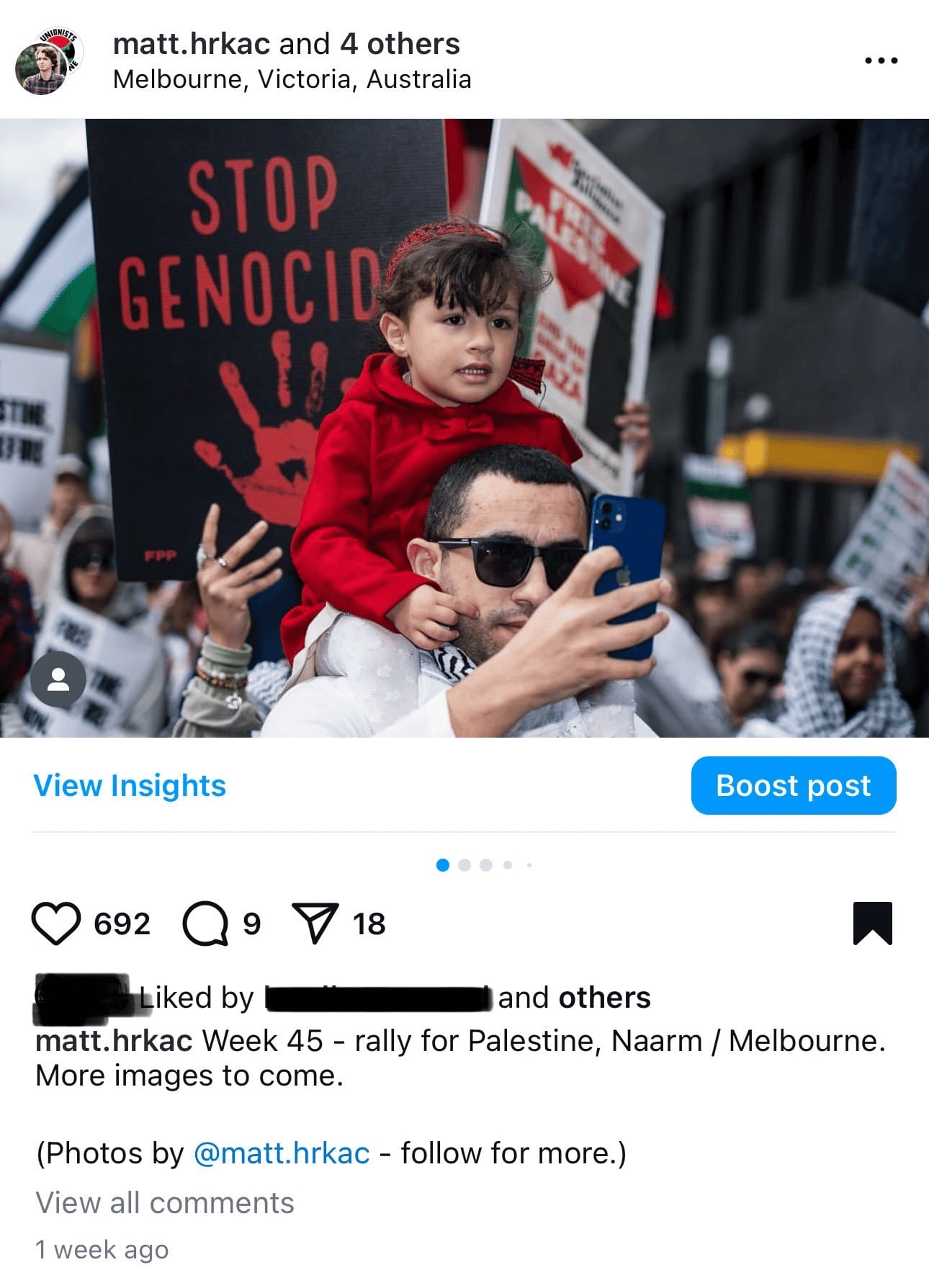
It's fair to say that a lot of photographers aren't good writers, and there may be instances where it's totally fine to use a single short sentence or even a description containing 2-3 words - especially if you're documenting and posting about a significant event that regularly occurs as part of a broader, ongoing protest movement.
In the example above - a quick and easy few words describing the latest in an ongoing sustained series of rallies is perfectly fine. If you're continually covering such actions, your audience will know what it's about from your previous posts, etc.
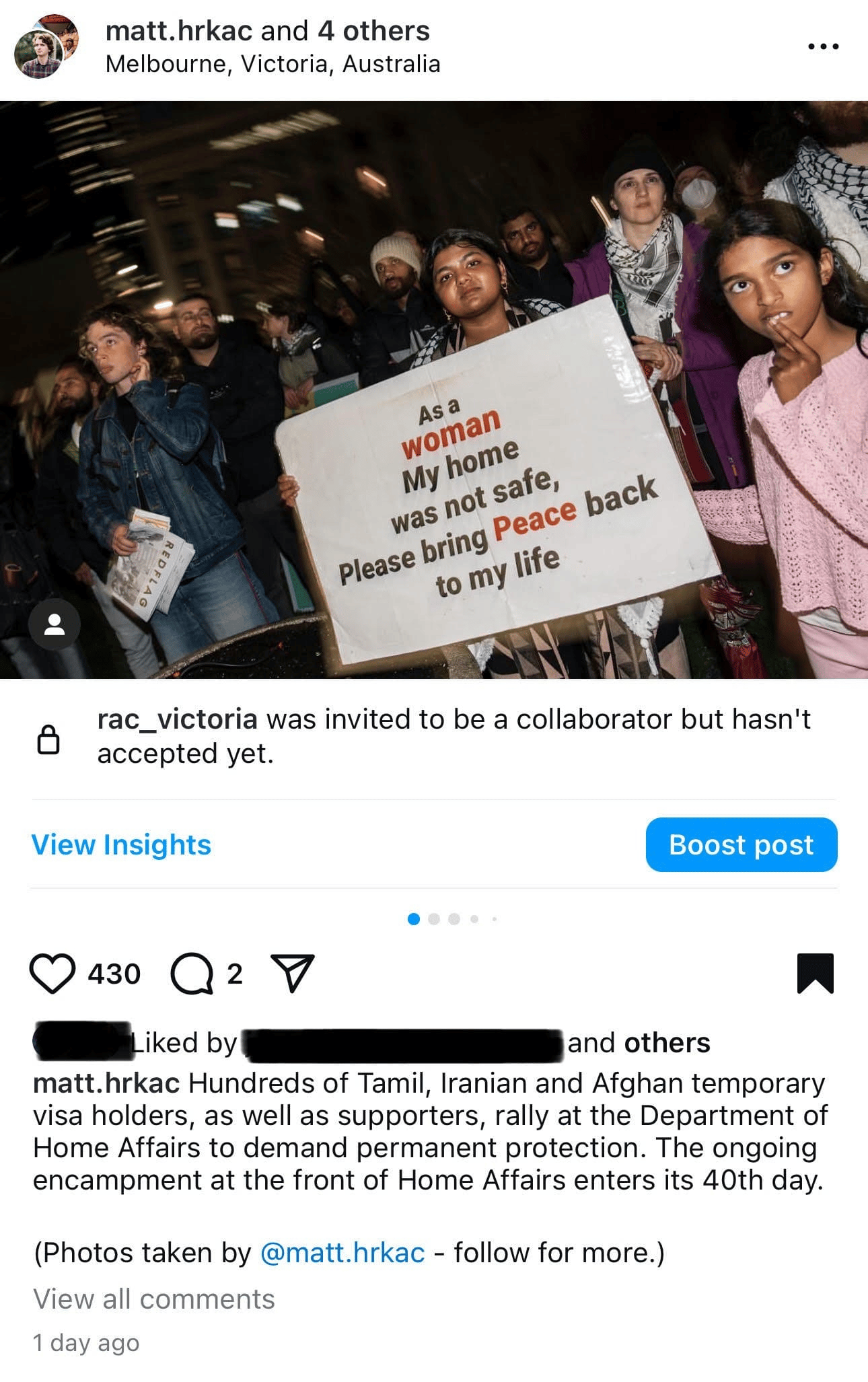
For the most part, however, you should be descriptive with your captions while also getting to the point, using 'who, what, when, where and why' as a guide.
Taking the example above and breaking it down:
Who?: Tamil, Iranian and Afghan temporary visa holders, and their supporters.
What?: A protest.
When?: [Note that posts on social media are generally date and time stamped and you don't really need to include this in the post itself.]
Where?: Department of Home Affairs.
Why?: To demand permanent residency.
Put that together and you've got yourself a succinct description that covers all bases.
I don't do this myself, but if you're struggling to come up with a description, you may wish to use AI tools to help you construct descriptions, plugging in the details of who, what, where, when and why and self editing the result to give it your own touch.
Be mindful also of tense. First of all, speak in the present tense and second of all, be consistent in speaking in the present tense. Don’t swap between present tense and past or future tense, for example.
Mistake 2: Posting a whole bunch of images that are disconnected from each other in a series
An image may be visually impressive however, in this field of work, it's more about constructing a narrative that's sustained throughout the whole series of images, then it is about how visually impressive an image is on its own.
That means if including an image in a series does a better job of holding the overall narrative of the series together, even if it's not as 'good' as another image - then it's best to opt for the image that's not as good.
You can always post the better looking image as a post on its own and you're probably going to have a bigger impact doing it that way.
Aim to talk about the different aspects of actions, limiting it to one per series of images.
For example: you may post a series of images that covers, broadly, a mass rally. But did other specific things happen during the course of that rally? If so, construct a series of images, one for each of those specific things that happened.
Publishing a bunch of random images that have no thought put into the narrative that ties ties them together will ultimately diminish the impact you're going to have.
Use plain language
You should aim to use plain language in your posts. This includes abbreviating sets of words (for example: writing 'we are' as we're, 'I am' = I'm, 'you are' = you're, etc), using legible sentence structures, using simpler words that mean the same thing where possible and avoiding jargon or technical language that might not be understood by a broad audience.
This isn't an academic exercise, you're speaking to everyday people, so it stands to reason that the language you choose to use should be non academic and be understandable to a broad audience.
Optional: Collaborations
Instagram now has a feature that allows you to collaborate on posts with up to five other accounts. If you wish, and you have a good relationship with the account holders - you can invite them as collaborators when you post on Instagram.
What this means is that your post, should those account's accept the collaboration requests, will appear in the Instagram feeds of their followers, as though they made the post.
This also means others can invite you to collaborate on their posts. It's totally up to you whether or not you accept these requests - I personally don't, even when it's my own work being used, mostly because I like to be in complete control of my own grid. But if you're not as pedantic on that as I am, you can go right ahead and accept those requests.
In conclusion
I write this guide because over my years of documenting protest actions, I've learnt a lot of lessons and gained plenty of valuable insights in terms of best practice and I want other documentary photographers (whether new or aspiring, and even current and established) to have these lessons in hand.
It's also important in the sense that having more people documenting protest movements being a good thing, so long as it's being done with ethics in mind.
In saying that, if you think there's something I've missed, you're more than welcome to reach out. If you found this guide to be helpful, please share.
Image below: Demonstrators stage a mock bombing at the Flinders Street Station intersection in Naarm (Melbourne), both to raise awareness of the plight of Palestinians in Gaza and to protest the RISING: Arts Festival which had received backing and funding from pro Israel groups.